Ascorbic acid appears in forms suited to very different routines, from compact tablets to bulk powder and rose-hip capsules. I prioritize serving size, format, ingredient simplicity, dietary fit, and the inconvenience of measuring or mixing. The right choice depends less on packaging than on dosage consistency, portability, and how often the product will be used.
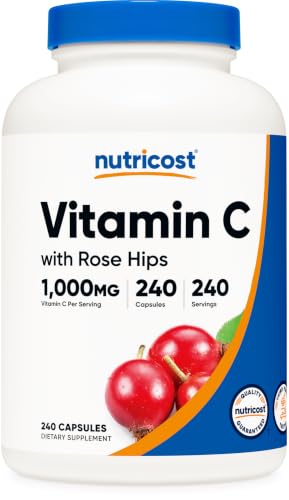
The 240-count bottle favors a routine that resists running out. Each capsule supplies 1,000 mg of vitamin C plus 25 mg of rose hips, a straightforward combination that avoids the measuring step required by powders.
For a home routine built around one capsule a day, the larger supply reduces replacement frequency. Compared with Nutricost Vitamin C with Rose Hips 120 Capsules, it takes more shelf space but offers the same core serving structure.
Useful Highlights
✓One capsule provides a clearly defined 1,025 mg serving.
✓The 240-count supply suits consistent daily use.
✓Rose hips complement the vitamin C without creating a complicated routine.
✓Capsules avoid loose powder and included measuring tools.
Small Caveats
•The larger bottle takes more cabinet space than the 120-count version.
•Capsule-based powder may be less attractive for people who avoid encapsulated products.
Key Details
Feature
Specification
Why It Matters
Vitamin C
1,000 mg
Defines the amount delivered by one capsule.
Rose hips
25 mg
Adds a recognizable plant-derived companion ingredient.
Supply
240 capsules
Suits routines that favor fewer replacement cycles.
Made For
This format best fits capsule users who value a long supply and a simple once-daily routine.
A Better Fit Elsewhere
Windmill Vitamin C 250 mg 100 Tablets is simpler for people who prefer a smaller tablet serving and 100 servings.
Portability drives this pick more than capsule count. The 120-count bottle fits more comfortably in a weekender, desk drawer, or travel pouch while preserving the familiar 1,025 mg serving found in the larger Nutricost option.
For someone building a short supplement supply, that balance is useful. The honest read is that this is simply the space-conscious version of Item 1, not a materially different formula.
Ester-C uses a calcium ascorbate complex, a form positioned as less acidic and closer to neutral pH than conventional ascorbic acid. That distinction may matter to people who prefer vitamin C in a gentler format, particularly as part of a daily capsule routine.
The pack contains 200 vegetable capsules across two 100-count bottles. Compared with Nutricost’s straightforward 1,000 mg serving, Solgar Ester-C Plus offers a different chemical form and a 500 mg capsule amount.
Practical Pluses
✓Calcium ascorbate metabolites form the core of the formula.
✓The stated pH-neutral profile suits people seeking less acidity.
✓Vegetable capsules accommodate a plant-based capsule preference.
✓The formula includes acerola berry, rose hips, and bioflavonoids.
Worth Noting
•The specialized complex may cost more than basic vitamin C powder.
•Two bottles take more shelf space than one compact container.
•Multiple companion ingredients make the label broader than a single-ingredient option.
Feature Snapshot
Feature
Specification
Why It Matters
Vitamin C form
Calcium ascorbate complex
Provides a less acidic alternative to standard ascorbic acid.
Amount
500 mg
Defines the vitamin C amount associated with the formula.
Total capsules
200
Provides a substantial capsule supply.
Companion ingredients
Bioflavonoids, acerola berry, rose hips
Adds several plant-derived components to the formula.
The Right Fit
This complex best fits capsule users who prioritize a less acidic vitamin C format and complementary plant ingredients.
Where Another Pick Shines
Nutricost Ascorbic Acid Powder 2 lbs is the cleaner fit for people wanting a single-ingredient powder and full control over serving size.
Crystal form gives this option more flexibility than a fixed capsule serving. The 8.8-ounce container provides 56 servings and supports everyday drinks, custom preparation, or portions adjusted to a specific routine.
For a busy kitchen, the crystals eliminate bottle-to-bottle comparison, though accurate measuring still matters. Unlike Earthborn Elements Vitamin C Powder 8 lb, this smaller supply is easier to move and more approachable for occasional use.
What Pays Off
✓Adjustable portions suit several preparation styles.
✓The 56-serving supply balances bulk value with manageable container size.
✓The formula excludes major allergens and several common dietary ingredients.
✓Crystals dissolve into drinks without a capsule shell.
Details To Watch
•Accurate measurement takes more care than swallowing a pre-portioned tablet.
•Powder can clump or spill during storage, so the container should remain properly closed.
•Acidic crystals may not agree with every stomach at larger servings.
Quick Facts
Feature
Specification
Why It Matters
Container size
8.8 oz
Offers a compact alternative to multi-pound powder.
Servings
56
Defines the stated use supply.
Ingredient amount
4,500 mg
Identifies the labeled amount of vitamin C crystals.
Dietary profile
Vegan, dairy-free, soy-free, and gluten-free
Supports several common dietary preferences.
Best Suited To
This container fits people who want adjustable vitamin C crystals without committing to a multi-pound powder supply.
Consider Something Else
Earthborn Elements Vitamin C Powder 8 lb serves high-volume blenders and custom preparation more efficiently.
Ingredient simplicity drives this selection. The two-pound container holds pure ascorbic acid powder without binders or fillers, and the included scoop makes repeatable one-gram servings easier to prepare.
That makes sense for home users who mix vitamin C regularly or want freedom to determine each portion. Bluebonnet Nutrition Vitamin C Crystals 8.8 oz uses a smaller container, while this pick prioritizes supply and a minimal label.
At approximately 2,000 mg per serving, this powder occupies the high-potency end of the list. Fine crystals are intended to mix easily, and the included scoop supports repeatable use across 120 stated servings.
The serving is substantially larger than the one-gram amount described for Nutricost Ascorbic Acid Powder 2 lbs. For people already accustomed to high-potency routines, that difference is meaningful rather than cosmetic.
Eight pounds makes this a working supply rather than a casual shelf add-on. The resealable container and ingredient-focused formula suit capsule filling, powder blending, and custom preparation where a large quantity is genuinely useful.
Compared with Nutricost Ascorbic Acid Powder 2 lbs, the key difference is scale. A home user making frequent drinks may find the smaller bottle easier to manage, while a workshop or shared preparation space can make better use of the larger container.
At 250 mg per tablet, Windmill offers the smallest straightforward serving in this group. The tablets require no powder, scoop, or mixing step, making them a practical fit for travel, desk use, and routines built around minimal handling.
The 100-count bottle provides 100 stated servings. Compared with the 1,000 mg Nutricost capsule, this may require more tablets to reach the same amount, but the trade-off is a simpler tablet format and a smaller per-serving amount.
The Case For It
✓Tablets offer the simplest handling in the roundup.
✓The compact bottle travels easily without loose powder.
✓Each tablet supplies a defined 250 mg amount.
✓One hundred servings support a straightforward tablet supply.
Room For Improvement
•Larger vitamin C amounts may require multiple tablets.
•The 100-count supply is shorter than the 200- or 240-count capsule options.
•Tablets provide no adjustable serving size.
Important Details
Feature
Specification
Why It Matters
Vitamin C amount
250 mg
Provides a smaller, clearly defined tablet serving.
Count
100 tablets
Supports 100 stated servings.
Made For
This tablet format fits travelers, desk-side routines, and people who want simple handling with smaller individual servings.
Look Elsewhere
Nutricost Vitamin C with Rose Hips 240 Capsules suits capsule users who want a larger serving in a long-lasting supply.
## What Matters Most Before Choosing Ascorbic Acids### Serving Amount And RoutineA lower tablet amount and a 1,000 mg capsule may suit different established routines, while a 2,000 mg powder serving serves high-potency use. I compare the labeled amount, tablet or capsule count, and powder serving before judging convenience.### Form And Stomach ComfortAscorbic acid is the basic vitamin C compound, while calcium ascorbate is a less acidic complex presented in the Solgar formula. That distinction may make Solgar Ester-C Plus more appealing for a capsule routine where acidity is a concern.### Portability Versus SupplyTablets travel cleanly, and 120 capsules fit a compact bag. By contrast, two-pound and eight-pound powder containers prioritize long supply but demand careful storage, accurate scooping, and protection from moisture.### Ingredient ScopePure powder offers the shortest ingredient path for custom preparation. Solgar adds acerola berry, rose hips, and bioflavonoids, while the Nutricost rose-hip capsules add 25 mg of rose hips to each 1,000 mg vitamin C capsule.## Making Supplement Decisions With Fewer Surprises### Mistakes Worth DodgingAvoid choosing solely by capsule count or bottle size. The serving amount, form, storage needs, and expected use matter more than packaging alone, especially between 250 mg tablets and high-potency powders.### The Upgrade PayoffA specialized ascorbate complex, plant-derived companions, or a much larger powder supply may justify spending more for a specific routine. The added cost needs a clear purpose, since basic pure powder already covers straightforward preparation needs.## Frequently Asked Questions### Is Ascorbic Acid the Same as Vitamin C?Ascorbic acid is the chemical name for vitamin C. Different products may deliver it in plain powder, tablets, rose-hip combinations, or calcium ascorbate complexes.### Should I Choose Capsules or Powder?Capsules offer pre-portioned, portable convenience, while powder provides adjustable serving sizes. Capsules suit low-fuss routines, whereas powder fits frequent mixers and custom preparation.### What Is the Main Difference Between Rose Hips and Vitamin C?Rose hips are plant material added alongside vitamin C in some formulas. Nutricost’s capsule provides 1,000 mg vitamin C and 25 mg rose hips per capsule.### Are Higher-Potency Powders More Convenient?No. A higher amount per serving does not remove measuring or mixing. Windmill Vitamin C 250 mg 100 Tablets is easier to carry, while high-potency powders suit people comfortable preparing larger servings.### How Should Vitamin C Powder Be Stored?Powder should remain in a tightly closed container and away from moisture. The resealable containers described for the bulk options help limit exposure, though scoops still need to stay dry and clean.## Wrap UpThe most practical choice depends on routine discipline: Windmill handles travel, Nutricost capsules simplify daily dosing, and the powders serve frequent mixers. Solgar Ester-C Plus stands apart for its less acidic calcium ascorbate approach, while larger powders make sense only when regular use justifies the supply. Form and serving matter more than a polished label.
Robert Wright
Robert Wright is a passionate food writer and home cook with hands-on experience exploring global flavors and culinary techniques. He combines research-based cooking knowledge with practical recipe testing to offer reliable and approachable guidance for home kitchens.