

A capable jerky machine has to manage more than heat. It needs enough tray space for a useful batch, steady airflow, precise controls, and a footprint that suits the kitchen. I compare these Magic Mill dehydrators by capacity, construction, temperature range, drying controls, and practical ownership demands.
The strongest options serve different needs. Compact kitchens may prefer the five-tray model, while frequent jerky makers need roomier interiors or independent dual-zone controls. These machines handle beef jerky, poultry, fruit, vegetables, herbs, and dog treats, but their differences in usable space and convenience are substantial.
A Side-By-Side Look

Magic Mill Premium 10-Tray 700W Dehydrator

Magic Mill Pro 7-Tray Stainless Dehydrator

Magic Mill Pro 10-Tray Stainless Dehydrator

Magic Mill Premium DualZone 16-Tray Dehydrator
Magic Mill Pro 7 XL-Tray Dehydrator
Magic Mill 11-Tray Adjustable Dehydrator

Magic Mill Premium 15-Tray 800W Dehydrator
Magic Mill Compact 5-Tray 240W Dehydrator
A Closer Look At Each Pick
The ten-tray layout gives weekend dehydrating sessions enough capacity without moving into the footprint of the 15-tray model. I see this as the more manageable middle ground for busy kitchens that regularly prepare jerky, fruit leather, or pet treats.
A 700W heater, 95° to 167°F range, and 48-hour timer cover common drying tasks. The rear fan supports more even circulation, while the transparent door reduces the need to open the cabinet during long runs.
Bright Spots
- Ten extra-large trays support a useful weekend batch of strips or snack portions.
- Rear-mounted airflow reduces manual tray rotation during typical use.
- Digital temperature and timing controls simplify repeated recipes.
- The viewing window makes progress easier to monitor without interrupting airflow.
Practical Considerations
- Ten suspended trays create more interior surface to clean after oily meat batches.
- Its 700W power level is less substantial than the 800W model, though that may not matter for home batch sizes.
Feature Snapshot
Made For
This model suits home cooks making several trays of jerky or preserved fruit during weekend batch sessions.
Consider Something Else When
The Magic Mill Premium 15-Tray 800W Dehydrator better serves households needing greater capacity in a single cycle.
Material construction defines this model more than raw capacity. Stainless steel covers the exterior, interior, and trays, a practical advantage for owners expecting frequent contact with moisture, fruit juices, and meat oils.
Seven full-size trays still offer room for several jerky varieties at once. Compared with the 10-tray Magic Mill Premium model, the cabinet is smaller, but the cleaning and storage demands may be easier to manage.
Practical Advantages
- The all-stainless interior resists routine corrosion and wipes clean more easily than plastic-lined cavities.
- A 600W rear fan and rear heat source encourage circulation across the tray stack.
- The 95° to 176°F range offers a little more upper-end heat than most 167°F models.
- Automatic shutoff completes the 48-hour timer without requiring constant supervision.
Smaller Trade-Offs
- Seven trays may require multiple cycles for large family batches.
- Owners commonly report the need to clean beneath each removable tray after greasy recipes.
- The unit requires adequate clearance around its exterior and exhaust path.
Key Attributes
The Right Fit
It fits home cooks who value cleanable metal construction and moderate batch sizes over maximum capacity.
Another Choice May Suit
The Magic Mill Pro 10-Tray Stainless Dehydrator offers more drying space for mixed-food households.
Ten stainless steel trays make this a practical middle-capacity machine for households producing several types of dried food. The space is well suited to separate batches of beef, poultry, fruit, and dog treats without doubling up on every cycle.
Rear airflow moves heat through the cabinet, and the transparent door brings the process closer at a glance. I’d favor this configuration over a smaller model for families that regularly dehydrate more than one recipe.
Positive Points
- Ten removable trays make portioning and batch organization straightforward.
- Digital temperature and timer controls support repeatable results.
- A keep-warm setting maintains finished batches without running the full drying cycle again.
- The transparent door reduces interruptions during progress checks.
- Rear circulation helps reduce hot spots within the tray stack.
Where It May Fall Short
- One shared control zone cannot process temperature-sensitive foods alongside higher-heat meat.
- Ten trays increase washing and drying time compared with the five-tray model.
Built With In Mind
This configuration suits families making weekly jerky, fruit snack, and pet treat batches in a home kitchen.
Reach For A Different Pick When
The Magic Mill Premium DualZone 16-Tray Dehydrator fits cooks who need two chambers with independent heat and timer settings.
Independent chambers solve a problem that conventional single-zone dehydrators share. I can set one side for higher-heat beef jerky while the other handles delicate herbs, which prevents one recipe from dictating the entire batch.
The 16-tray format adds capacity, and French doors improve access to both chambers. This is the most specialized design here, making the extra complexity worthwhile mainly for mixed-temperature cooks.
What Stands Out
- Two independent temperature controls allow contrasting foods to dry simultaneously.
- Separate 48-hour timers provide useful scheduling flexibility in each chamber.
- Sixteen trays support high-volume jerky, fruit, vegetable, and pet treat production.
- French doors make loading and unloading more direct.
- Keep-warm mode gives finished batches a controlled holding setting.
Trade-Offs To Consider
- The dual-zone layout occupies more space than any single-chamber model here.
- Two controls and larger doors increase the number of surfaces requiring routine cleaning.
Technical Highlights
Who Will Love This
It suits experienced home dehydrators running meat and delicate plant foods at the same time.
Swap It Out When
The Magic Mill Compact 5-Tray 240W Dehydrator is a more practical fit for limited counters and small batches.
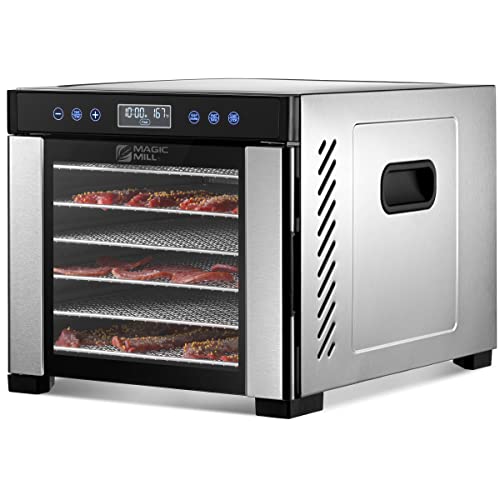
Seven extra-large trays make this model feel more substantial than its compact tray count suggests. It suits first-time dehydrators who want meaningful batch capacity without filling an entire countertop with a 10-, 15-, or 16-tray cabinet.
The digital controls cover temperature, timing, and finished-batch holding. Compared with the Metal Mill Pro 7-Tray Stainless Dehydrator, the materials are less uniformly specified, so construction priorities may matter more here.
A Few Strong Suits
- Seven XL trays create a useful balance of capacity and manageable size.
- Digital controls simplify changes between jerky, herbs, fruit, and meat.
- A keep-warm function reduces the need to time the immediate end of a cycle.
- Rear airflow supports drying across the vertically arranged trays.
Minor Gripes
- The shared chamber prevents simultaneous low- and high-temperature recipes.
- XL tray spacing may limit oversized fruit or long vegetable sections.
- Removable trays need careful washing and complete drying before storage.
Who It Suits Best
This model fits beginners and couples producing moderate jerky, fruit, and herb batches in a standard kitchen.
A Better Fit Elsewhere
The Magic Mill Premium 10-Tray 700W Dehydrator suits families that regularly need more output per cycle.
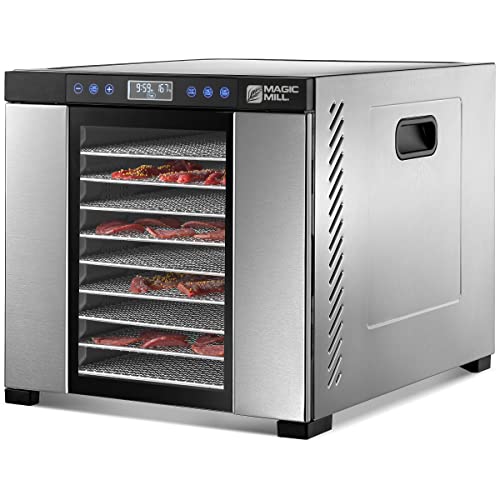
Eleven trays place this model near the top of the single-zone group for capacity. Its slim housing is intended to preserve drying room without pushing the cabinet into the oversized territory occupied by the 15-tray model.
The 95° to 167°F digital range covers the common needs of jerky makers. A 24-hour timer and overheat protection add practical control, particularly for beginners establishing repeatable recipes.
Useful Touches
- Eleven stainless steel trays support multiple jerky and fruit batches in one run.
- Digital temperature settings use 9-degree increments for incremental adjustments.
- The slim profile preserves capacity without an especially broad cabinet footprint.
- Overheat protection adds a practical safeguard during unattended drying.
Points To Note
- The 24-hour timer is shorter than the 48-hour settings on several larger models.
- Eleven layers of food contact and tray supports make cleanup fairly involved.
- Single-zone control cannot separate jerky from temperature-sensitive herbs.
Made For
It suits high-capacity home kitchens that prefer one large chamber over independent zones.
Where A Sibling Pick Shines
The Magic Mill Premium 10-Tray 700W Dehydrator offers a similar layout with a longer timer for extended recipes.
Fifteen extra-large trays create the largest single-chamber batch here. Serious jerky schedules benefit from that room, particularly when poultry, beef, and fruit need separate trays during the same run.
An 800W heater adds capacity relative to smaller models, but the cabinet demands more counter and shelf space. The practical question is output, not novelty: frequent batch cooks can use the size, while occasional cooks probably won’t.
Key Advantages
- Fifteen XL trays support large, varied batches in a single chamber.
- The 800W heating specification suits sustained drying sessions.
- Rear fan placement supports airflow from the back of the cabinet.
- A transparent door makes long drying progress easier to monitor.
- The 48-hour digital timer accommodates extended programs.
Room For Improvement
- The large cabinet requires substantial storage and counter clearance.
- Fifteen trays and supports create a substantial post-cycle cleanup.
- A shared temperature setting cannot handle mixed heat requirements at once.
Feature Rundown
The Right Fit
It belongs in dedicated kitchens with ample space and a high-volume jerky routine.
Another Choice May Suit
The Magic Mill Pro 7 XL-Tray Dehydrator serves occasional cooks who need less capacity and easier cleanup.
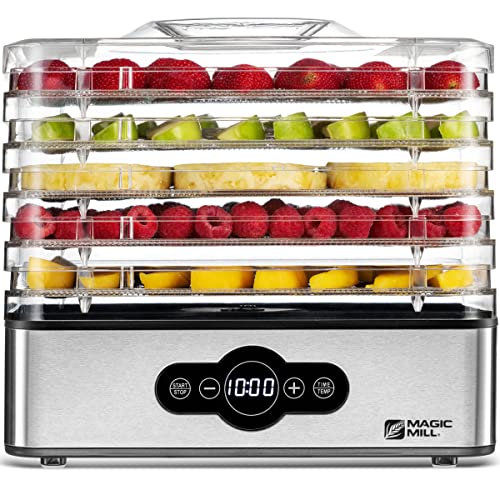
The five-tray layout makes this the sensible choice for apartments, compact kitchens, and people learning which foods dehydrate well. It handles a meaningful starter batch without demanding the storage space required by the larger cabinets.
A 240W heater and 48-hour timer provide basic programmability, while temperatures up to 167°F cover the stated range of jerky, fruit, herbs, and pet treats. In a small kitchen, the reduced cycle count can matter more than raw capacity.
Well-Handled Touches
- Five stackable stainless steel trays keep the cabinet compact and easy to organize.
- The 48-hour timer supports extended drying programs despite the smaller capacity.
- Digital temperature adjustment reaches 167°F for common jerky and fruit work.
- The lower 240W power specification suits everyday countertop use.
Some Limits To Know
- Small batches require several cycles for holiday-scale jerky production.
- Compact tray spacing may not suit oversized produce pieces.
- Cleaning five tray layers remains less convenient than working with a flat multi-tray rack.
Perfect Match For
This model fits apartment residents and beginners making modest quantities of dried snacks.
Look Elsewhere When
The Magic Mill 11-Tray Adjustable Dehydrator better fits households that regularly process full-size batches.
What Matters Before Choosing a Dehydrator
Capacity and counter space
Tray count matters only as much as the cabinet can support. I’d compare usable tray area, not just the number listed, because spacing affects food size and airflow. Large households may fill 11 or 15 trays, while apartment kitchens often gain more from a compact five-tray design.
Temperature and timer controls
A digital thermostat provides steadier adjustment than a basic mechanical dial. Long timer settings also reduce the need to stop a cycle early or restart finished batches. Keep-warm and automatic shutoff functions are convenient for multi-step food preservation.
Construction and upkeep
Stainless steel trays are easy to rinse and generally tolerate repeated moisture exposure. Interior surfaces and tray supports still require attention because small fragments collect in seams. A larger machine saves cycles but creates more parts to wash and store.
Avoiding Common Dehydrator Missteps
Pitfalls Shoppers Hit
A crowded tray can seem efficient but restrict airflow. I’d leave space around food and avoid stacking pieces that prevent warm air from circulating. Oversized ingredients also fail to dry evenly, so trimming fruit, vegetables, and meat into manageable pieces matters.
What the Higher Tier Adds
The Upgrade Payoff
Additional trays reduce repeated cycles, while dual-zone controls prevent temperature-sensitive foods from sharing settings with high-heat jerky. The extra capability is practical for frequent users, but it also means a larger cabinet and more cleanup. Compact users gain little from capacity they rarely use.