

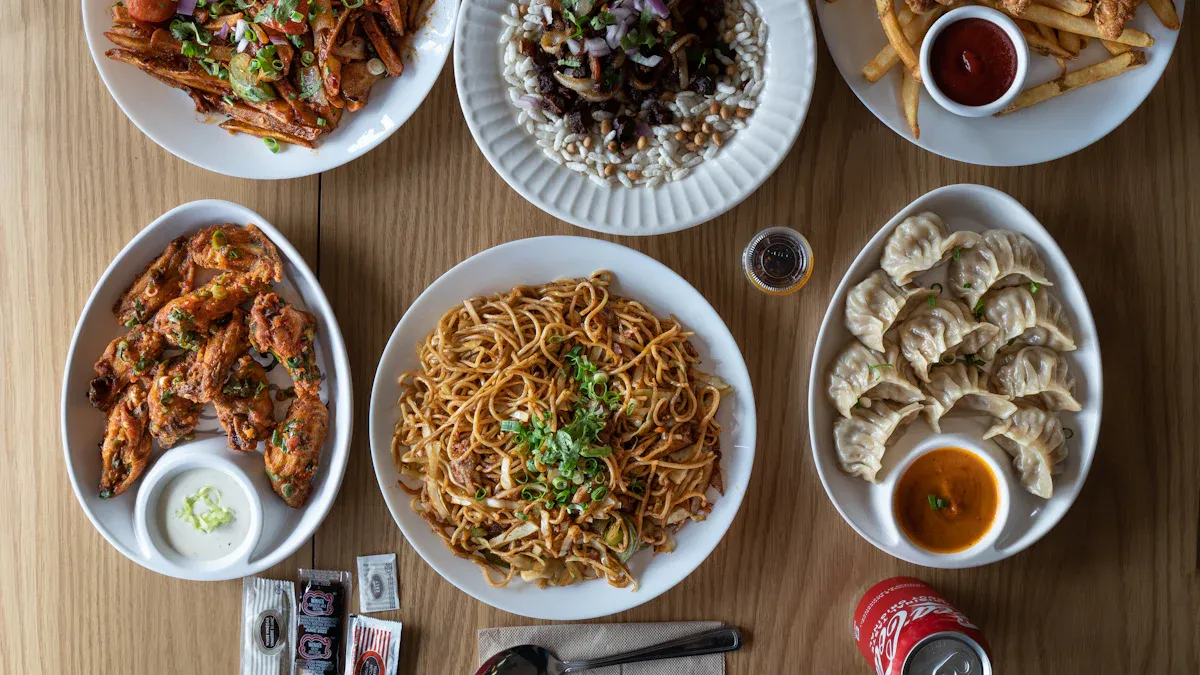
You probably know how food can bring people together, no matter where they live. Around the world, some dishes stand out and become part of daily life for millions. Take a look at these favorites:
Pizza from Italy, with billions sold every year
Sushi from Japan, loved for its variety
Curry from India, packed with spices and stories
Jerk Chicken from Jamaica, full of bold flavors
Clam Chowder from the United States, always comforting
Ceviche from Peru, fresh and zesty
Each dish tells a story. Some recipes carry family traditions, special spices, or even memories from different times in history. When you try iconic recipes, you taste more than just food-you taste culture.
Key Takeaways
Food connects people across cultures. Trying iconic recipes allows you to experience different traditions and flavors.
Each iconic dish has a unique story. From Neapolitan pizza to kimchi, these recipes reflect the history and culture of their regions.
Look for authentic versions of these dishes. Seek out certified restaurants or local markets to enjoy the true flavors.
Cooking iconic recipes at home can be rewarding. Use traditional ingredients and methods to bring a taste of the world to your kitchen.
Exploring global cuisine enriches your culinary knowledge. Each dish offers a chance to learn about the people and traditions behind it.
Iconic Recipes: Neapolitan Pizza
Neapolitan pizza stands as one of the most iconic recipes in the world. When you think of Italian food, this pizza probably comes to mind first. It has shaped how people everywhere see pizza, and it continues to inspire new recipes and flavors.
Origin
You can trace Neapolitan pizza back to Naples, Italy. People in Naples started with simple flatbreads, but by the 18th century, they had created something special. Neapolitan pizza began as a street food for the city’s working class. It used easy-to-find ingredients like tomato, garlic, and cheese. Mozzarella became the star, giving the pizza its creamy taste. The word “pizza” even shows up in Italian texts from as early as 997 AD. In 1889, a pizza maker named Raffaele Esposito made the famous Pizza Margherita to honor Queen Margherita of Savoy. He used tomatoes, mozzarella, and basil to match the colors of the Italian flag. By 1807, Naples already had 54 pizzerias, showing how popular this dish had become.
Did you know? The arrival of tomatoes from the New World changed pizza forever, making the classic Neapolitan style possible.
Uniqueness
What sets Neapolitan pizza apart from other iconic recipes? The answer lies in its ingredients and cooking method:
The dough uses ’00’ flour, which makes the crust soft, chewy, and a little crispy.
San Marzano tomatoes, known for their sweet taste, get hand-crushed for the sauce.
Fresh mozzarella, either from buffalo or cow’s milk, melts into a creamy layer.
Fresh basil and extra virgin olive oil add aroma and shine.
Bakers cook the pizza in a super-hot oven (800-900°F) for just 90-120 seconds. This creates a thin, soft center and a puffy, leopard-spotted crust.
Where to Try
You can find authentic Neapolitan pizza in many places, not just Italy. Look for pizzerias certified by the Associazione Verace Pizza Napoletana (AVPN). Over 1,000 pizzerias in 58 countries have this certification. The European Union also protects the name and recipe under the “Specialità Tradizionale Garantita” (STG) label. Only pizzerias that follow strict rules can call their pizza “Neapolitan Pizza STG.” If you want the real deal, check for these signs when you travel or eat out.
Certification Body | Number of Affiliated Pizzerias | Countries Represented |
|---|---|---|
Associazione Verace Pizza Napoletana (AVPN) | Over 1,000 | 58 countries |
Global Cuisine: Tom Yum Kung
Origin
Tom Yum Kung is one of those iconic recipes that you find in almost every Thai restaurant. This soup has a long story in Thai culture. You can see its journey in the table below:
Year | Event Description |
|---|---|
1898 | The first written evidence of Tom Yum Kung appears in the Lexicon Dictionary of Sweet and Savory Recipes in Western and Siamese Styles. |
1964 | A recipe similar to modern Tom Yum Kung is recorded in the Food of the Royal book. |
2011 | Tom Yum Kung is registered as a National Cultural Heritage of Thailand. |
2024 | Tom Yum Kung is inscribed on the UNESCO Representative List of Intangible Cultural Heritage of Humanity. |
People in Thailand have enjoyed this soup for over a century. It started as a simple dish but grew into a symbol of Thai identity. Today, you can find it everywhere, from street food stalls to fancy restaurants.
Uniqueness
What makes Tom Yum Kung stand out in global cuisine? You taste a mix of spicy, sour, salty, and sweet in every spoonful. The soup uses fresh prawns, but the real magic comes from the herbs and spices. Here’s a quick look at what goes inside:
Ingredient | Description |
|---|---|
Kaffir Lime Leaves | Adds a zesty fragrance, often torn before adding to the soup. |
Chillies | Thai bird’s eye chillies provide characteristic spiciness, adjustable to taste. |
Mushrooms | Varieties like straw or oyster mushrooms are commonly used. |
Lime | Juice adds refreshing acidity to the soup. |
Fish Sauce | Contributes a salty and savory dimension. |
Sugar | A small amount balances the flavors. |
Cilantro | Fresh leaves used as a garnish. |
Lemongrass | Provides a refreshing, citrusy aroma and flavor. |
Galangal | A root with a unique ginger-like flavor, used for its aromatic qualities. |
You get a burst of flavor from every ingredient. The broth smells fresh with lemongrass and kaffir lime leaves. The prawns stay juicy and never overcooked. Some chefs, like Sittikorn “Ou” Chantop, say the best Tom Yum Kung lets the prawns shine and keeps the soup from getting too sweet.
Where to Try
If you want to taste authentic Tom Yum Kung, Thailand is the place to go. Here are two famous spots:
Restaurant Name | Location | Description |
|---|---|---|
AKKEE | Nonthaburi | A One MICHELIN Star restaurant known for its authentic tom yum kung, emphasizing the use of fresh prawns and traditional flavors. |
Mit Ko Yuan | Bangkok | Renowned for its creamy tom yum goong, made without evaporated milk, highlighting the natural flavors of freshwater prawns. |
At Mit Ko Yuan, you get a creamy, rich soup with a bright orange color. The creaminess comes from prawn oils, not milk.
AKKEE focuses on using the freshest prawns and classic Thai flavors.
Tom Yum Kung shows you what makes Thai recipes so special. You taste history, culture, and a love for bold flavors in every bowl.
International Recipes: Couscous
Origin
Couscous stands out as one of the oldest international recipes you can find. When you look at its history, you see deep roots in North African culture. People have enjoyed couscous for thousands of years. Archaeologists found wild grain seeds and grinding tools in the Tassili n’Ajjer region, dating back to about 18,000 BC. That means people used grains long before couscous became a household name.
You can check out some fascinating historical records in the table below:
Evidence Type | Description |
|---|---|
Historical Manuscript | A 13th-century cookbook from the Maghreb and Andalusia mentions Moroccan vegetable couscous. |
Archaeological Finding | Primitive jars of couscous found in tombs from the reign of Berber king Massinissa. |
Culinary Reference | Couscous described in a 13th-century Aleppo recipe book as Moroccan (couscous al-maghribi). |
People in the Sahara made couscous before the desert even formed. Proto-Berber groups moved south and started growing millet for couscous in the Sahel. You can see how this dish became a symbol of North African life.
Uniqueness
What makes couscous different from other iconic recipes? You prepare it with a special pot called a couscoussier. This two-part pot lets the grains steam above a simmering broth. The steam gives couscous a light, fluffy texture that you can’t get from boiling. The grains soak up the flavors from below, making every bite delicious.
Couscous also plays a big part in family traditions. Women often gather to make it for celebrations. You might see couscous at weddings or during the end of Ramadan. It brings comfort and a sense of home to everyone at the table.
Tip: If you want to try making couscous, use a couscoussier for the best results. The grains will turn out soft and never sticky.
Where to Try
You can taste authentic couscous in many places. Here are some top spots:
Restaurant Name | Location | Cuisine Type | Description |
|---|---|---|---|
Talis | The Residence Douz, Tunisia | Tunisian and Berber | Specializes in traditional cooking techniques, offering various couscous and meat dishes cooked to tender perfection. |
El Bahia, New York City: This restaurant brings North African flavors to the U.S. You can try classic couscous and other international recipes from the Maghreb.
Couscous remains a favorite among iconic recipes. When you try it, you taste history, tradition, and the warmth of North African hospitality.
Kimchi
Origin
When you think about Korean food, kimchi probably pops into your mind first. This dish has a long history that stretches back centuries. You can find references to kimchi and its main ingredient, cabbage, in many old Korean texts. Take a look at this table showing some important historical sources:
Historical Source | Description |
|---|---|
Hunmongjahoe by Choi (1527) | Contains references to cabbage, indicating its presence in Korean cuisine. |
Dongkuk-isangkukjip by Lee (1241) | Early mention of cabbage in Korean literature. |
Dongmunseon by Seo (1478) | Another classical work referencing cabbage. |
Sakajip by Seo (1488) | Includes mentions of cabbage, contributing to the kimchi narrative. |
Jeompiljae by Kim (1497) | Further documentation of cabbage in historical texts. |
Poem by Kyubo Lee (13th century) | Indicates that radish kimchi was common during the Goryeo period. |
Historical account from the Three Kingdoms Period | Describes kimchi made from Chinese cabbage and Korean red chili pepper, linking it to cultural practices. |
You see how kimchi has always been a part of Korean life. People used cabbage and radish, mixing them with spices to create something special.
Uniqueness
Kimchi stands out from other recipes because of its fermentation process and ingredients. You get a mix of flavors that is hard to find anywhere else. Here’s what makes kimchi unique:
Kimchi fermentation uses lactic acid bacteria like Lactobacillus, Leuconostoc, and Weissella.
The process depends on ingredients, salt, and temperature.
Main ingredients include Chinese cabbage, garlic, ginger, and chili powder.
Traditional kimchi uses baechu cabbage, salted and fermented in ceramic jars.
People often bury these jars in the ground, which helps control temperature and flavor.
The fermentation is quick compared to other foods, and the high levels of lactic acid bacteria give kimchi its tangy taste.
You soak cabbage in salt water to soften the leaves before fermenting.
Common ingredients also include radish, garlic, ginger, and chili powder.
You get a crunchy texture, spicy kick, and sour notes all in one bite. The variety of raw materials and the special fermentation steps make kimchi different from other fermented foods.
Why It’s a Favorite
Kimchi is more than just a side dish. You find it at almost every Korean meal, making it a true staple. People love kimchi for its bold flavor and health benefits. Here’s why kimchi is one of the favorite recipes around the world:
Kimchi is packed with probiotics, which help your gut and digestion.
Studies show kimchi may have anticancer, antiobesity, antiaging, and immune-boosting effects.
The communal practice of kimjang, where families gather to make kimchi, brings people together and keeps traditions alive.
The rise of Korean culture, like K-pop and K-dramas, has made kimchi popular worldwide.
Tip: If you want to explore global recipes, kimchi is a great place to start. You get a taste of history, culture, and health in every bite.
Baguette
Origin
When you think about French food, the baguette probably comes to mind right away. This bread has a long story in France. The baguette started to become popular in the 19th century, during the industrial revolution. Bakers wanted a bread that was easy to carry and quick to bake. The baguette’s long, thin shape made it perfect for people to tuck under their arms as they walked home. In 1920, a new law in France set rules for bread making. This law helped make the baguette look and taste the same everywhere. After World War II, the baguette became a symbol of hope and recovery for the French people. Today, you see it as a true icon of French culture.
Fun fact: The word “baguette” means “wand” or “stick” in French!
Uniqueness
What makes the baguette stand out from other breads? You only need four simple ingredients: flour, water, salt, and yeast. Bakers mix these and let the dough rest for up to two days. This slow process gives the bread a deep flavor. Some bakers use a starter called “la Poolish” to make the taste even better. When you bite into a baguette, you notice the crisp crust and the soft, airy inside. The outside turns a golden brown, while the inside stays moist and full of little holes. The shape is long and skinny, which is different from most breads. Making a perfect baguette takes practice, but the result is worth it.
Key features of a classic baguette:
Long and thin shape
Crunchy crust
Creamy, open crumb inside
Where to Try
If you want to taste the best baguettes, you should visit France. Paris has many famous bakeries, but you can find great baguettes all over the country. Here are some top spots:
Bakery Name | Location | Special Note |
|---|---|---|
Boulangerie Utopie | Paris | Winner of the 2024 Best Baguette in Paris |
Boulangerie Lemarchand | Plessé | Best Traditional Baguette prize, 2024 |
Boulangerie Hemmer | Martigues | Best baguette in Bouches-du-Rhône, 2023 |
Boulangerie des Canuts | Lyon | Known for unique fermentation process |
Boulangerie Pinot | Vosges region | Grand Est’s best traditional baguette winner |
You can also find baguettes in bakeries around the world, but nothing beats the taste of one fresh from a French boulangerie. If you love trying new recipes, you might even want to bake your own at home!
Lavash
Origin
When you look at Armenian cuisine, lavash stands out as one of the oldest and most meaningful flatbreads. You find its roots deep in history, with some historians tracing the first mentions of lavash back to around 6,000 years B.C. This bread is more than just food-it’s a symbol of Armenian identity and daily life. People use lavash in many ways, from wrapping kebabs to serving it as a plate or even as a utensil. You also see lavash in special ceremonies. For example, families cover the shoulders of newlyweds with lavash to wish them well-being and fertility. UNESCO recognizes lavash as an Intangible Cultural Heritage, showing how important it is to the region.
Lavash is a key part of Armenian culture and daily meals.
The bread appears in traditional ceremonies, like weddings.
UNESCO lists lavash as a shared heritage among several countries.
Uniqueness
What makes lavash different from other flatbreads? You notice the special way people prepare and bake it. Bakers start with a simple dough of wheat flour, water, and salt. They roll it into thin sheets and stretch it over oval molds. The real magic happens when they slap the dough onto the hot walls of a tonir, which is an underground clay oven. The bread bakes in less than a minute, giving it a soft texture with crisp edges. After baking, people hang lavash on wires to dry, and it can last for months. Baking lavash is not just cooking-it’s a ritual. Families often sing songs and chant while making it. The first lavash of the day goes to someone who is sick, and in the past, soldiers carried it for protection.
Preparation Method | Description |
|---|---|
Dough Preparation | Wheat dough mixed with water and salt, rolled thin, stretched over molds. |
Baking Technique | Dough slapped onto tonir oven walls, bakes in 30–60 seconds. |
Drying Process | Hung on wires to dry, can be stored up to a year. |
Cultural Rituals | Baking includes songs and chants, recognized by UNESCO. |
Special Practices | First lavash given to the sick, used by soldiers for protection. |
Where to Try
You can taste authentic lavash in Armenia, where it remains a daily staple. In Yerevan, the GUM Market lets you choose between thin and thick lavash, fresh from local bakers. If you travel to Yeghvard, a village near Yerevan, you find home bakers making lavash in traditional ovens. They often serve it with cheese and fresh herbs, giving you a true taste of Armenian recipes. Lavash also appears in Armenian restaurants around the world, but nothing matches the experience of eating it straight from the tonir.
Strapatsada
Origin
Strapatsada is one of those Greek recipes that feels like summer on a plate. You find its roots in the Ionian Islands, especially Corfu. Historians believe Strapatsada likely started during the Venetian period in Corfu. Some say it may have been a Jewish creation, since Jewish communities in Greece began using tomatoes in their cooking by the mid-18th century. You can spot Strapatsada in Jewish cookbooks, such as the Cookbook of the Jews of Greece and Tastes of Sephardic Thessaloniki. This dish shows how different cultures in Greece shared ideas and flavors over time.
Strapatsada likely originated during the Venetian period in Corfu.
Jewish communities in Greece may have created it, adding tomatoes to their cuisine in the 1700s.
Jewish cookbooks from Greece include recipes for Strapatsada.
Uniqueness
What makes Strapatsada stand out among Mediterranean egg dishes? You notice the difference right away in the ingredients and the way you cook it. The dish uses high-quality olive oil, ripe tomatoes, onion, paprika, eggs, dried Greek oregano, sea salt, and black pepper. Some versions add feta cheese and fresh herbs for extra flavor.
The cooking method is simple but special. You start by sautéing onions in olive oil until they caramelize. Then, you add grated tomatoes and let them simmer until thick. Next, you add eggs-sometimes beaten, sometimes whole. The eggs cook gently, so the whites set but the yolks stay runny. This gives Strapatsada a creamy texture and rich tomato flavor.
Key ingredients: ripe tomatoes, extra-virgin olive oil, eggs, feta cheese, oregano, salt, and pepper.
Technique: grate fresh tomatoes, cook them down, then add eggs for a soft, creamy finish.
Why It’s a Favorite
Strapatsada is a favorite in Greece for many reasons. You can make it quickly with just a few ingredients, especially when tomatoes are in season. The dish uses local produce like fresh tomatoes and feta, which fit perfectly with the Mediterranean diet. People love Strapatsada because it is healthy, simple, and full of flavor. You often see it served for breakfast or a light lunch, especially in the summer when tomatoes taste their best. The focus on nutritious, locally sourced food makes Strapatsada a true reflection of Greek culture.
Made with fresh, local ingredients like tomatoes and feta.
Healthy and easy to prepare.
Popular in summer, when tomatoes are at their peak.
Samosas
Origin
When you bite into a samosa, you taste a story that started centuries ago. Samosas first appeared in the Middle East around the ninth century. Traders and travelers carried them along spice routes, and soon, you could find samosas in South Asia. In India, cooks added their own spices and fillings, turning samosas into a favorite snack. This journey shows how recipes can travel and change as people share ideas and flavors.
Did you know? Samosas became popular in India after arriving from the Middle East, showing how food connects cultures.
Uniqueness
What makes samosas stand out from other snacks? You notice the crispy pastry and the spicy filling right away. Samosas come in many shapes and sizes, depending on where you find them. Some are small and flaky, while others have thick crusts. The fillings change from place to place. You might get potatoes, peas, and spices in one region, or minced meat and onions in another. Some places add peanuts, raisins, or even tuna. In Western countries, you can find samosas with cheese or chocolate.
Here’s a quick look at how samosas change across regions:
Region | Unique Fillings and Preparation Styles |
|---|---|
General | Potatoes, peas, lentils, and spices; deep-fried in oil. |
East India | Smaller singara with potatoes, peanuts, and sometimes raisins; flaky texture. |
Hyderabad | Lukhmi with minced meat or onion filling; thicker pastry crust. |
South India | Different folding style; fillings include potatoes, peas, carrots, and spices; often eaten without chutney. |
Bangladesh | Shingara filled with potatoes and nuts; somosa with onions and minced meat. |
Nepal | Singadas served with chickpea or green pea curried soup instead of chutney. |
Somalia/Kenya | Sambusa influenced by Indian and Middle Eastern flavors. |
Portugal/Brazil | Chamuça with Goan and Indian influences; innovative fillings like cheese and chocolate in Western countries. |
In Somalia and Kenya, you find sambusa with Indian and Middle Eastern flavors.
In Portugal and Brazil, chamuça brings Goan and Indian influences.
In some Western countries, samosas surprise you with cheese or chocolate fillings.
Where to Try
You can taste authentic samosas in many places. In India, you find flaky singara, spicy potato samosas, and Lukhmi with meat or onion. Pakistan offers Punjabi samosas with spicy potatoes, Lahori Chicken Samosa, and Kaghzi samosa with a thin, crispy wrapper. Bangladesh serves shingras filled with potatoes and nuts, and somosa with meat and onions. Nepal’s singada comes with chickpea or green pea soup. In the Maldives, bajiya features tuna. Southeast Asia has Burmese samosas in salads and Indonesian versions with local fillings. Across Africa, samosas are smaller and filled with meat or vegetables.
If you want to explore global recipes, samosas give you a taste of history and creativity in every bite.
Rigatoni alla Buttera
Origin
Rigatoni alla Buttera comes from the heart of Tuscany, Italy. You find this pasta dish in the countryside, where farmers and ranchers once needed hearty meals after long days of work. The word “buttera” refers to Tuscan cowboys, known as “butteri.” They worked on the land and wanted food that filled them up and tasted rich. Over time, this dish became a favorite in Tuscan homes and trattorias. Today, you see it on menus across Italy, but it still carries the spirit of the countryside.
Uniqueness
What sets Rigatoni alla Buttera apart from other pasta recipes? You notice the difference right away when you look at the ingredients and how cooks prepare the sauce. This dish uses a mix of meats that you do not find in most pasta dishes. Here is what you usually find in the sauce:
Prosciutto, which adds a salty and savory flavor
Pancetta, giving the sauce a smoky taste
Beef sausages, making the dish hearty and rich
Cooks slowly simmer these meats with tomatoes, peas, and sometimes a splash of cream. The slow cooking lets all the flavors blend together. The sauce becomes thick and full of depth. Rigatoni pasta, with its ridges, holds onto the sauce, so every bite bursts with flavor. You get a dish that feels rustic, bold, and comforting.
Tip: If you want to taste the real depth of this dish, look for places that use traditional slow-cooking methods.
Where to Try
You can find Rigatoni alla Buttera in many trattorias throughout Tuscany. Florence and Siena have restaurants that serve this dish just like the butteri enjoyed it. Some famous spots include Trattoria Mario in Florence and Osteria Le Logge in Siena. These places use local meats and fresh pasta, so you get an authentic taste. If you travel outside Italy, look for Italian restaurants that focus on regional dishes. Some chefs in the United States and the UK now offer Rigatoni alla Buttera on their menus, bringing a taste of Tuscany to your table.
Pancakes
Origin
Pancakes are one of those foods you find almost everywhere. People have made some form of pancake for thousands of years. You see pancakes in ancient Greek and Roman times, where cooks mixed flour, eggs, and milk to make simple flat cakes. Today, you can spot pancakes in nearly every country, each with its own twist. No matter where you travel, you will likely find a version of this dish on breakfast tables or at street food stalls.
Uniqueness
What makes pancakes so special? You notice that every culture puts its own spin on them. Some pancakes are thin and delicate, while others are thick and fluffy. The ingredients and toppings change from place to place. Here are a few ways pancakes show up around the world:
In France, you get crêpes-thin pancakes filled with chocolate, fruit, or ham and cheese.
Russia serves blini, often made with buckwheat flour and eaten during the Maslenitsa festival.
Sweden has pannkakor, which are thin and usually served with jam.
Germany calls them Pfannkuchen, and they can be sweet or savory.
In Japan, okonomiyaki is a savory pancake packed with seafood or vegetables.
The United States loves buttermilk pancakes, which are thick and fluffy, often stacked high and covered in maple syrup.
South Africa’s pannekoek comes from Dutch roots and can be filled with sweet or savory treats.
France also has galettes, a savory version made with buckwheat flour.
You see that pancakes can be sweet or savory, simple or fancy. Some are eaten for breakfast, while others are part of festivals or special meals.
Why It’s a Favorite
Pancakes are a favorite because they bring comfort and joy to so many people. You can make them quickly with just a few ingredients. They work for breakfast, lunch, or even dessert. Many families have their own pancake traditions, like Sunday morning stacks or special holiday recipes. Pancakes let you get creative with toppings-think syrup, fruit, whipped cream, or even cheese and meats. No matter where you are, pancakes feel like comfort food. They remind you of home, family, and good times shared around the table.
Tip: Try pancakes from different countries to discover new flavors and traditions. You might find a new favorite!
You just explored what makes these recipes iconic around the world. Each dish brings a piece of its culture to your table. Trying global cuisine lets you taste new flavors and learn about different traditions. Why not pick one recipe and give it a try? Share your experience in the comments! 🍽️ What’s your favorite iconic recipe? Let’s talk food!
FAQ
What makes a recipe iconic?
A recipe becomes iconic when people from many places know and love it. You see it in daily life, celebrations, and even pop culture. These dishes often tell a story about their country or region.
What is the best way to try authentic global recipes?
You get the best experience by visiting local restaurants or markets in the dish’s home country. If you can’t travel, look for places run by people from that culture. Cooking at home with traditional ingredients also helps.
What ingredients do you need for most iconic recipes?
Most iconic recipes use simple, local ingredients. You often find flour, rice, vegetables, meats, and spices. The secret is in how you prepare and combine them.
What should you know before making an international dish at home?
You should read the recipe carefully and gather all your ingredients first. Some dishes need special tools or spices. Watching videos or asking someone from that culture can help you get it right.
What is the best way to share your favorite recipe with others?
You can invite friends over for a meal, post photos online, or write about your cooking experience. Sharing food brings people together and lets everyone learn about new cultures.